

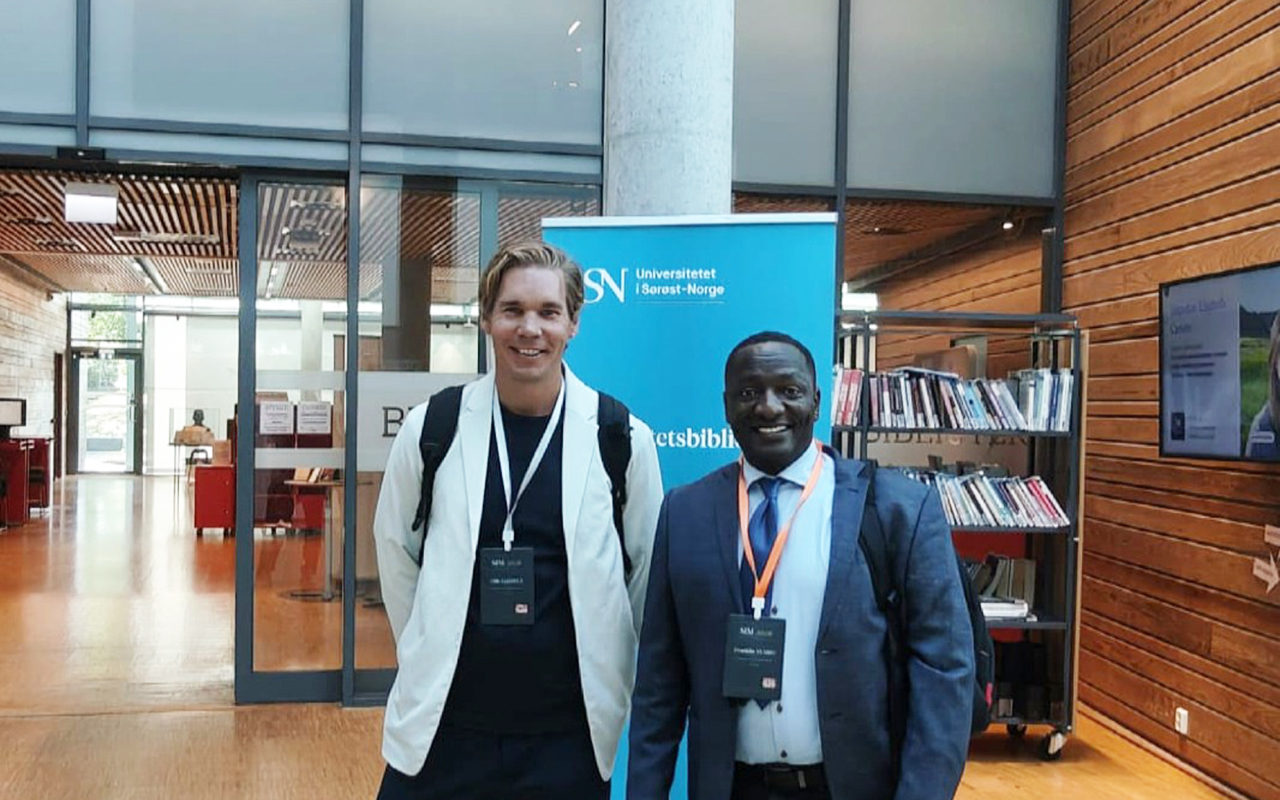
Project Leader Franklin Nyairo and Project Researcher Ville Lehtelä at the USN SIM Conference in Norway in 2026.
AI can support the assessment of maritime students’ performance in simulator-based training, but it still struggles to understand the wider context behind a student’s decisions. This is one of the key findings of research conducted at the i-MASTER project at Novia University of Applied Sciences.
The i-MASTER project is funded by the European Union and the research was carried out in collaboration with seven partner organizations across five European countries, including UiT The Arctic University of Norway (coordinator), the University of Gothenburg (Sweden), Fraunhofer CML (Germany), VTI (Sweden), the University of South-Eastern Norway (USN), Novia University of Applied Sciences (Finland), and WU Vienna University of Economics and Business (Austria).
The AI-based tool, the Intelligent Learning System (ILS), developed in the project assesses students’ performance in maritime navigation simulator exercises and generates written feedback on their performance. At Novia’s Aboa Mare simulator, five students tested the system by completing a range of navigation scenarios. Seven maritime simulator instructors and teachers from three Nordic higher education institutions also participated in the study. They assessed the students’ performance and compared their own evaluations with the feedback generated by the ILS.
The findings were presented by Project Leader Franklin Nyairo and Project Researcher Ville Lehtelä at the USN SIM Conference in Norway in 2026, where they shared insights on the limitations and potential of AI-based assessment in maritime simulator training.
From monitoring parameters to understanding situations
Situational awareness emerged as a key theme in the research conducted by Ville Lehtelä.
“Situational awareness is one of the most important aspects that an instructor should assess in a student’s navigation performance,” Lehtelä says.
Situational awareness can be divided into three levels. At the first level, the student understands what is happening in the surrounding environment and how the equipment being used works. At the second level, the student understands how changes in the environment affect their own actions.
At the third level, the student is able to look ahead, anticipate future situations and adapt their actions accordingly.
The AI performed particularly well when students’ performance could be assessed using clearly defined and measurable parameters. For example, it could analyse how accurately a vessel stayed on its planned route, the distances maintained from other vessels and how navigation tasks were carried out according to predefined parameters.
The situation became more challenging as the navigation scenarios became more dynamic.
“The more variables there are in a navigation situation, the more challenging it is for AI to assess the student’s performance,” Lehtelä says.
When numbers do not tell the whole story
One of the examples examined in the study was the Williamson turn, which can be used, for example, in a man-overboard situation. The AI assessed the performance based on predefined parameters, such as the time window set for initiating the turn.
If a student started the turn slightly outside the predefined time window but otherwise completed the manoeuvre successfully, the AI could give the performance a very low score.
“This made it clear that AI does not understand the whole situation, even when the student performs the task well,” Ville Lehtelä says.
The instructors participating in the study considered situational awareness one of the most important aspects to assess in a student’s performance. At the same time, this ability to understand the situation as a whole is precisely what AI currently finds more difficult to assess.
AI as a support tool for instructors
The aim of the research is not to replace maritime instructors with AI. Instead, AI could support instructors, particularly in situations where the performance of several students needs to be monitored simultaneously.
In classroom-based desktop simulator environments, up to 20 students can carry out navigation exercises at the same time. Monitoring and assessing all students simultaneously can be cognitively demanding for an instructor.
AI can analyse the performance of several students simultaneously based on predefined navigation parameters and generate written feedback. This could provide instructors with additional information and help identify areas where students need to improve.
For the technology to be used more widely in education, however, it would need to become more user-friendly and integrate better with existing simulator environments. During the project, the system was integrated into Novia’s simulator for research purposes, but it has not been used in regular teaching. Wider implementation would require further technical development and cooperation with simulator manufacturers.
From practical maritime work to research
Ville Lehtelä brings a strong practical maritime background to his research. He holds a Bachelor of Maritime Studies degree and has worked as a deck officer on Finnish merchant vessels, including passenger ships and cargo ships. He also has experience in maritime safety training and shipbuilding. Franklin Nyairo, who co-authored the research, brings complementary expertise in educational technology and human-automation interaction, strengthening the project’s interdisciplinary approach to evaluating AI in maritime education.
Moving from practical working life into research has also changed the way he approaches problems.
“The biggest change, coming from practical working life, has been learning to look at things from a theoretical perspective and apply theory to practice,” Lehtelä says.
It is precisely this combination of practical maritime experience, education and new technology that provides the foundation for research seeking new ways to train future seafarers more effectively and safely.
”The research continues to inform the development of AI-assisted assessment tools, with the clear message that technology should complement, and not replace, the professional judgment of maritime instructors. As the industry moves toward greater digitalization, maintaining this human-in-the-loop approach will be essential for ensuring both safety and pedagogical quality in maritime education”, Franklin Nyairo concludes.