

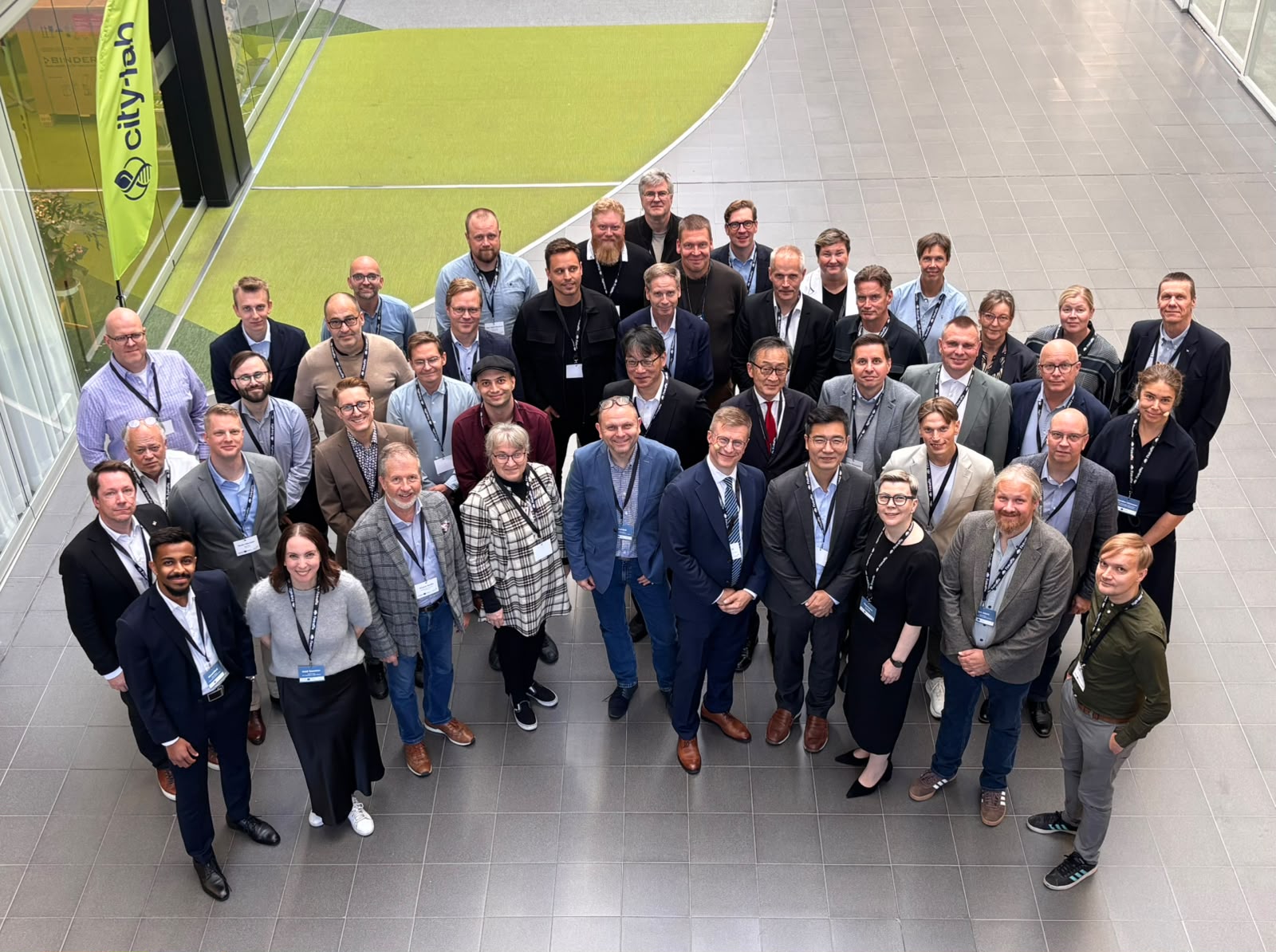
The participants at MaDaMe final seminar on the 30 September 2026.
The MaDaMe project is coming to an end, and a final seminar was held at the Joki Visitor Centre in Turku, Finland on the 30th of September 2026. Novia UAS was involved in developing, testing and evaluating new digital services for information sharing and messaging in fairway navigation.
More than 50 participants attended the seminar in person, and around 70 joined online. The project is co-funded by the Interreg Baltic Sea Region programme.
MaDaMe, short for Maritime Data Methods for Safe Shipping, is a three-year project supporting national authorities responsible for maritime traffic management in developing shared, cyber-secure digital services for maritime transport in the Baltic Sea region.
”The MaDaMe project may be coming to an end, but the development work and the transition towards e-navigation continues. MaDaMe has played an important role on this journey, and we are proud to have contributed to it,” says Project Manager Ahmed Elhadi from Novia University of Applied Sciences.
Digital services for safer maritime traffic
The project is coordinated by Turku University of Applied Sciences. The other partners are the Danish Maritime Authority, Digital Maritime Consultancy (DMC), the National Institute of Telecommunications (NIT), Sternula A/S, NavSim Poland Ltd., the Finnish Transport Infrastructure Agency, DFDS, Fintraffic and the Swedish Maritime Administration.
Juho Pitkänen from Fintraffic VTS highlighted the role of digitalisation in improving communication between vessels and shore-based VTS services. He explained how the S-100 framework provides a common structure for maritime information and can support more standardised and interoperable digital services.
“The MaDaMe project has also focused on developing and testing new digital services for time-critical information exchange. These include navigation warnings, route exchange and digital traffic clearance.”
According to Pitkänen, practical implementation and testing are essential for developing digital services and standards that are genuinely useful for VTS operators and other maritime stakeholders.
Near real-time information for vessels
The MaDaMe project demonstrated how near real-time information on aids to navigation can be delivered directly to vessels. The service provides mariners with up-to-date information on changes to aids to navigation, for example when a buoy is unlit, has moved or is otherwise experiencing a change in status that influences the safety of navigation.
The tests showed that this information can be delivered to vessels within minutes of a change being recorded. While further work is needed before the service can be fully integrated into future ECDIS systems, the technical foundations for exchanging this information are already in place.
“MaDaMe showed that near real-time information on aids to navigation can already be delivered to vessels. The technical solutions are there, and this kind of service can be used for different purposes even before it becomes part of future ECDIS systems,” says Tuomas Martikainen from the Finnish Transport Infrastructure Agency.
The project also explored the digital delivery of navigational warnings through the S-124 service. Christopher Saarnak from the Danish Emergency Management Agency presented how the service can make safety-critical information more readily available to mariners and described the steps needed to establish S-124 as part of the future digital maritime safety information framework.
Digital traffic clearance for VTS
Sirpa Kannos from Fintraffic VTS presented the Traffic Clearance Service (TCS), a digital service designed to support communication between VTS operators and vessels. During the MaDaMe pilots, the service was tested in cooperation with Fintraffic, the Finnish Transport Infrastructure Agency, Aboa Mare, and Novia UAS. The testing showed potential for clearer and more traceable communication, while routine communication could increasingly be handled digitally and leave VHF channels available for urgent and safety-critical communication.
“Digital traffic clearance will not replace voice communication but complement it. The two forms of communication will need to work side by side for a long time,” says Kannos.
Experts discuss the future of digital maritime services
Other speakers at the seminar included Tero Jokela, Project Manager at Turku University of Applied Sciences, Thomas Christensen from Digital Maritime Consultancy (DMC), who spoke about Maritime Connectivity Platform (MCP), Mads Svendsen from Sternula, who spoke about VDES and communication channels for digital e-Navigation services, and Caroline Johansson from the Swedish Maritime Administration (SMA), who presented MaDaMe impact on standardization and international cooperation.
The panel discussion, “Who Benefits from the Digital Maritime Services?”, brought together Minsu Jeon from the International Association of Marine Aids to Navigation and Lighthouse Authorities (IALA), Esa Kallio from Fintraffic VTS, Ulla Bjørndal Møller from the Danish Emergency Management Agency (DEMA), Olli Taipale from Finnpilot Pilotage and Jussi Vaahtikari from ESL Shipping. The seminar was moderated by Toni Sobott from the Finnish Transport Infrastructure Agency (FTIA).